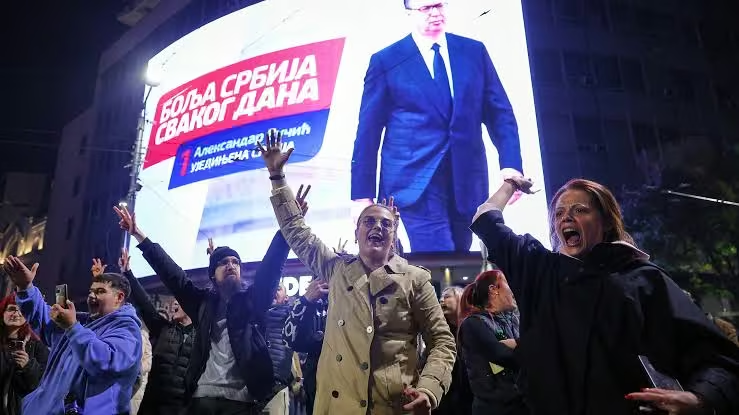
Vučić admits defeat in Serbia’s parliamentary election
Serbia’s former president Aleksandar Vučić conceded defeat in the country’s parliamentary election on Sunday. The result ends his long hold on power as the strongman nationalist leader.
Vučić said he expected the grassroots Student List to have won up to 140 of the Serbian parliament’s 250 seats. He made the statement at the headquarters of his Serbian Progressive Party (SNS). A near-record turnout of 65 percent was recorded an hour before polls closed, Serbia’s election commission said.
“It is clear that we lost these elections, the student-blockade list won,” Vučić said as counting got under way. The admission brought relief among Serbs who feared he might use voter fraud to retain power.
Years of student protests challenge SNS control
Vučić has held power for the past 12 years. Like former Hungarian premier Viktor Orbán, he built a massive state apparatus that helped enable his political survival. That setup eventually led to a popular revolt against his rule. Orbán conceded defeat in Hungary’s parliamentary elections in April.
The student-led resistance against the perceived autocracy and corruption of the rightwing Vučić administration has drawn support across the Balkan nation since the protests began two years ago.
Celebrations break out in Belgrade
Celebrations broke out in central Belgrade after Vučić’s announcement. Student List supporters danced, blew whistles and set off fireworks. Drivers in their cars held up three fingers to indicate the movement’s number on the ballot paper. They chanted “Vučić on his way out, Vučić on his way out”.
Later, Student List supporters gathered on the steps of Serbia’s parliament. They displaced SNS loyalists who had earlier amassed by the building.
Andjela Markovic, a nurse from Belgrade, said the movement had “sent the mafia of Vučić and SNS into retirement. Serbia is a normal country again, we proved that we can be just like any other nation, where people love their country and love each other even when they disagree”.
“I can’t remember a time before Vučić, I was eight when he came to power, but I hope I won’t remember him either in a few years,” said Marko Radojevic, a student from Novi Sad. “I’m so happy, I feel totally liberated.”

Parallel counts show Student List ahead
The Center for Free Elections and Democracy (CeSID), an NGO that monitors elections in Serbia, and pollster Ipsos forecast that Student List had won 52.9 percent of the vote while SNS was on 38.8 percent after a near-complete parallel count.
| Party | Vote share | Details |
|---|---|---|
| Student List | 52.9% | Projected up to 140 of 250 seats |
| Serbian Progressive Party (SNS) | 38.8% | Vučić’s party after near-complete count |
Vučić, who called the election last month, was aiming to swap the presidency for the prime minister’s office if SNS won the election.
“SNS conducted a weaker campaign,” said Helena Ivanov, a researcher at the Henry Jackson Society in London. “The students have mobilised lots of new voters.”
Analysts see a difficult transition ahead
The Student List will have a tough task to put the country back on a pro-European path, fix its democratic institutions, end graft and heal internal divisions, analysts said.
“Serbian voters sent such a clear message that they had had enough of a corrupt, authoritarian and criminalised regime that no amount of massaging the results could have masked the defeat of Vučić’s SNS,” said Milos Damnjanovic, an analyst with the BIRN consultancy in Belgrade. “To his credit, Vučić did what few expected and conceded defeat.”
Milan Nič, a senior research fellow of the German Council of Foreign Relations, warned that Vučić would have prepared for such an outcome. He added: “This is not over yet. Transition after 14 years of SNS power is just starting; Vučić can retreat and start a protracted handover but won’t give up power easily. This will be a huge test of the Serbian constitutional order with captured institutions.”
Ursula von der Leyen and António Costa, respectively presidents of the European Commission and European Council, said in a joint statement: “Today, the people of Serbia turned out in record numbers to shape their country’s future.
“Congratulations to the Student List on its victory in the parliamentary elections. We stand ready to support reforms on the rule of law, media freedom, the fight against corruption and strong democratic institutions, and to work together to advance Serbia’s future in the European Union.”
Hungarian premier Péter Magyar drew attention to the parallels with the shift in power in Budapest.
“Vučić conceded defeat,” he said on Facebook. “The Student List will get an absolute majority at the elections. Serbia erupts in nationwide celebrations. Ring a bell?”