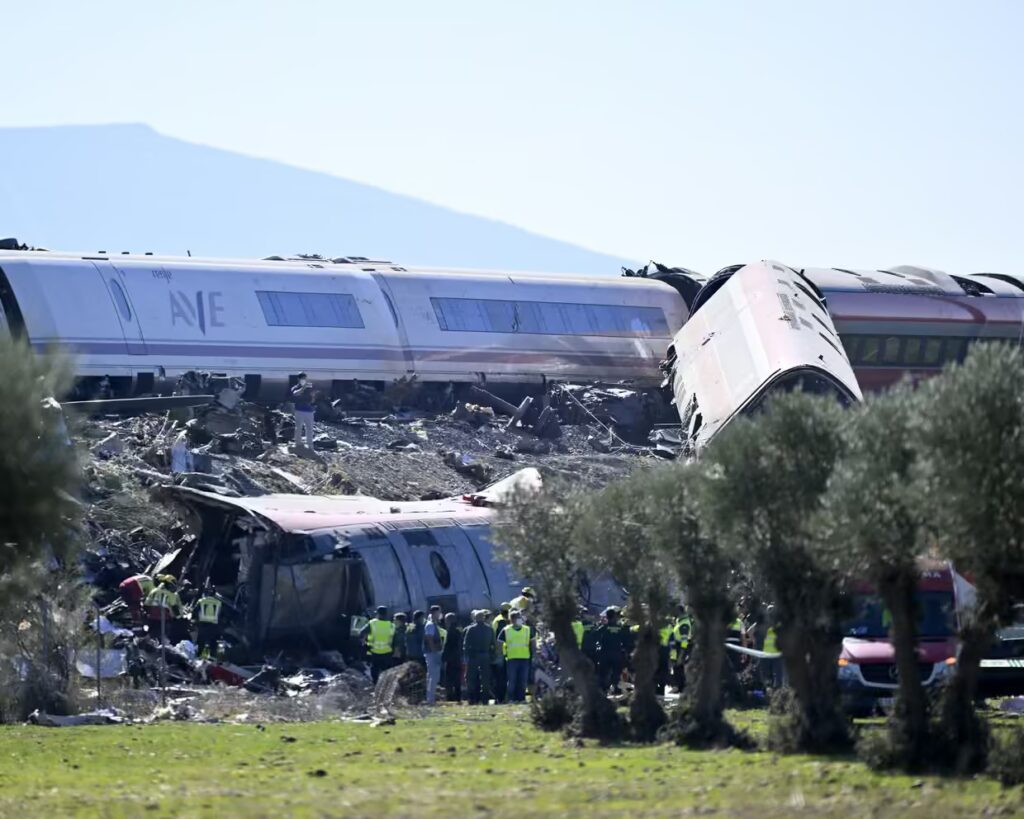
Spain’s high-speed rail network is the most extensive in Europe and the second largest in the world after China. For years it has been a source of national pride. Wednesday’s deadly crash, the second in nine months, has shifted attention back to questions about safety.
What happened near Toledo
Officials said at least 64 people were killed on Wednesday morning after two trains collided and several carriages derailed. The trains carried a combined 544 passengers.
The cause has not been confirmed. A source told Reuters that a train run by the private operator Iryo had stopped near Toledo because of a signalling fault and on instructions from infrastructure manager Adif. Shortly afterwards a Renfe train travelling on the same line at high speed hit the stationary Iryo train.
Renfe stated that its train had been told to continue and then struck the Iryo train “for reasons we don’t know.”
Parallels with the January crash

The accident follows a crash in January near Adamuz in Andalucía that killed 46 people and injured dozens more. Media quickly noted the similarities: both involved the same operators and occurred on the Madrid–Andalusia line, the oldest section of Spain’s high-speed network.
The January crash prompted a wider discussion about safety on that route. Rail unions say the debate has not gone away.
Union action and ongoing safety demands
Wednesday’s disaster came the day before a planned 24-hour stoppage at Renfe by Spain’s largest train drivers’ union. The union said earlier this month that its aim is “to change the system and make it safer.”
Its demands include climate-emergency protocols, clearer channels for workers to raise concerns, and guarantees that trains are “reliable and safe.” The union has also called for “real and definitive technical solutions to the safety and reliability issues that have long plagued our rolling stock.” It has separately called a rolling six-day strike for drivers at the high-speed operator Ouigo.
Investment, growth and the safety record

The January crash led to political argument over whether Pedro Sánchez’s government had spent enough on railway maintenance. Train travel accounts for about 57% of all transport in Spain. Passenger numbers on high-speed services rose 40% between 2019 and 2024 as the network was opened to private operators. In the first half of this year, 25 million people used high-speed trains.
The government says it has raised spending on railway-network maintenance by 54% since taking office in 2018. Spain spent more than any other country on its high-speed network between 2018 and 2022, averaging about €1.5 billion a year according to a Reuters analysis of EU data. More than 90% of the network has the highest level of safety-control systems used in the EU.
Most of the money has gone into new lines. Roughly 16% has been allocated to maintenance, renewal and upgrades. European Commission figures indicate that maintenance spending on Spain’s roughly 4,000 km of high-speed track has lagged behind levels in Germany and Switzerland, though differences in the age of the lines and the cost of works partly explain the gap.
Until this year Spain recorded among the lowest accident rates in the EU, with one or fewer fatalities per thousand kilometres of track according to Eurostat. The country’s worst rail disaster remains the 2013 crash outside Santiago de Compostela, in which 80 people died after a train left the track on a curve.
| Detail | January crash (Adamuz) | Wednesday crash (near Toledo) |
|---|---|---|
| Fatalities | 46 | At least 64 |
| Operators involved | Same pair of operators | Iryo and Renfe |
| Route | Madrid–Andalusia | Madrid–Andalusia |
| Known factors | Under investigation at the time | Signalling fault; Iryo halted on Adif orders; Renfe continued at speed |