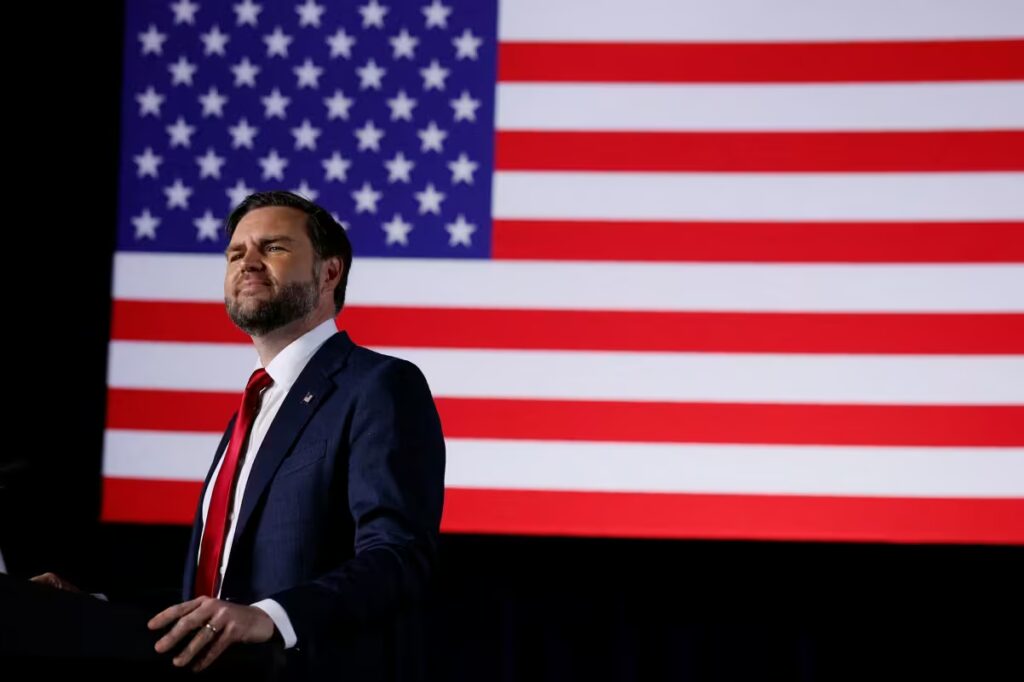
Vice President JD Vance looked over the damaged MAGA coalition on Wednesday and laid out his thoughts in a blunt social media post that effectively started the 2028 presidential race.
President Donald Trump, meanwhile, enjoyed what Interior Secretary Doug Burgum called a day of celebration. In the unfinished White House ballroom, he watched the final beam rise to the roof the way a sports team hangs a championship banner.
The contrast was jarring and marked a clear shift in the Trump era.
The president seemed either unaware or unbothered that his focus on a personal building project captured the same inattention to Americans’ cost-of-living pressures that hurt the GOP in the midterms. While talking with reporters, he did not appear downcast about his party’s heavy losses. He seemed freer, able to concentrate on building a physical legacy.
“Envision chandeliers all over here soon. Envision marble floor. Oh, it’s going to be beautiful. This will be the most beautiful building,” the president said.
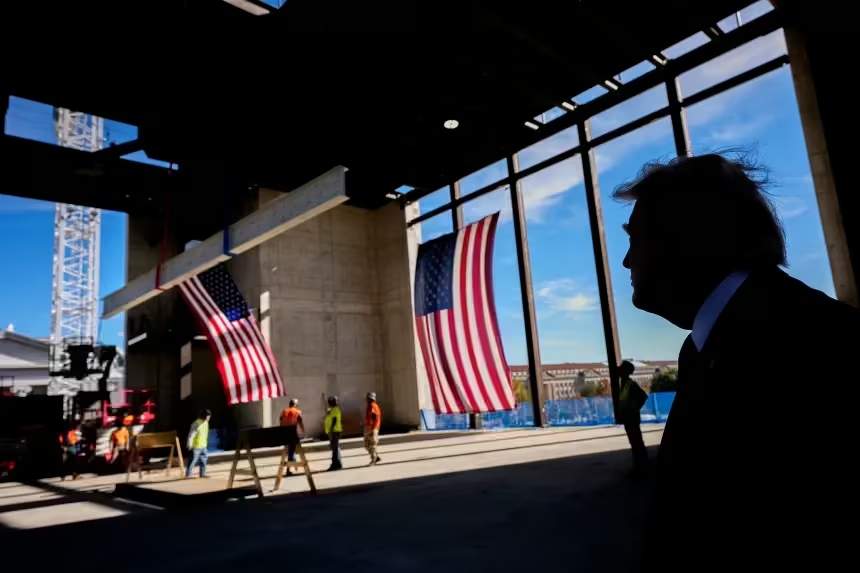
While Trump considered more gold fittings, Vance faced a harder job: pulling the Republican Party out of the loss of both the House and the Senate. The vice president is now running his own construction project, a new electoral coalition that could also protect his presidential ambitions.
Vance’s frank post, which included several pointed criticisms of his boss’s presidency and second-term approach, stood out for a vice president only hours after a major White House defeat.
Vance seeks to claim leadership role
The post read as an early claim to sit at the front of the group of GOP leaders trying to chart a different course. It was clearly calculated. Whether it was smart is another question. Just two weeks earlier, Vance’s judgment looked shaky after he backed a harsh attack ad that backfired on Ohio gubernatorial candidate Vivek Ramaswamy.
Vance wrote, with clear understatement, that he agreed with one GOP pollster that “our economic messaging wasn’t sharp enough down the stretch,” a stretch when Trump spoke of a “golden age” while gasoline and diesel prices climbed. He also tried to create distance from the president on two defining parts of the term: the Iran war and the aggressive removal of undocumented migrants.
“The reason we lost is the war,” he wrote, then added, “I’m open to the idea that we should change enforcement by focusing more on businesses that hire illegal labor, for instance.” On that point he built a straw man, implying the only alternative was “amnesty” pushed by “gaslighting” establishment politicians.
The vice president said he asked an unnamed pollster, “one of the smartest people I know in politics,” what would bring disaffected Trump/Vance voters back. The answer came as a short list:
| Priority | Focus Area |
|---|---|
| 1 | End the war |
| 2 | Focus on cost of living/inflation |
| 3 | Put America First |
| 4 | Change our relationship to Israel |
Vance also defended Fox News host Rachel Campos-Duffy’s calls for a diplomatic end to the Iran war. With Trump widely reported to be weighing new strikes, the defense signaled a possible break with the president.
He was careful to note that when he named the war as the reason for Republican losses, “the president said so last night.” He has not publicly split with Trump on the conflict, and he led the negotiating team that produced an MOU with Tehran over the summer, an agreement that collapsed once it met reality.
Still, the wording leaves room for a real difference. Trump now talks about the war’s midterm impact almost wistfully, presenting himself as a leader who knowingly accepted a political cost, paid through higher gas prices, to do what he believed was necessary. “I would have done nothing different,” he said Wednesday.
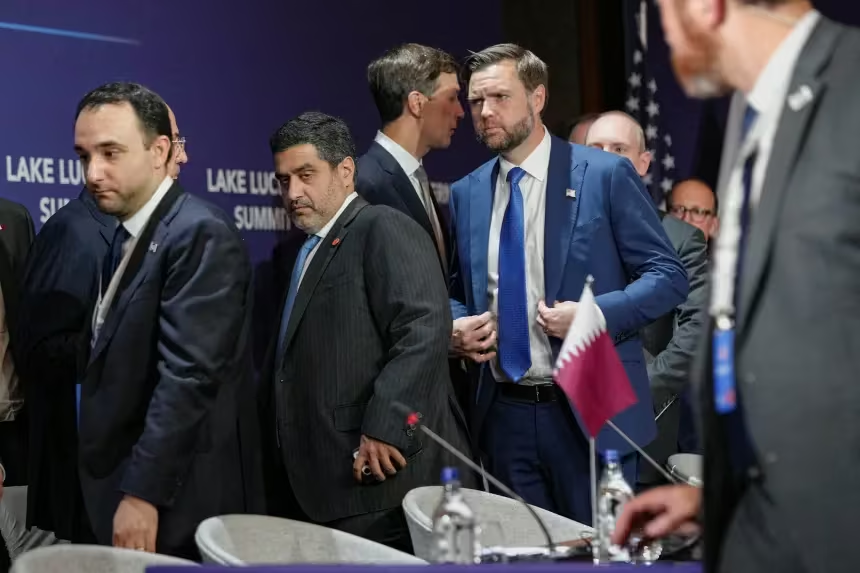
Vance’s comments allow the opposite reading: that the war was a mistake from the start and exacted a heavy political price. “If you’d like to argue it was worth it, that losing the Senate for the next 6 years was worth it, then do so,” he wrote. “Argue it was a worthwhile cost to pay. Agree or disagree, that’s at least honest. But everyone knows why we lost. And any honest conversation about where we go from here must start there.”
Trump avoided any public disagreement by telling reporters during the tour that Vance was “probably right” about the war’s impact because it “drove the gasoline up a little bit short term.”
The vice president then tried to quiet talk of a rift by posting video of Trump calling the statement “good” during the ballroom tour.
DeSantis is also leading the postmortem
Vance’s position on the war has long drawn interest because it softens his earlier skepticism of foreign military interventions, a view shaped by his service in Iraq. By including “America First” and a changed US-Israel relationship among his four points, he also appeared to reach toward the isolationist Tucker Carlson wing of what remains of the MAGA coalition, a group that may matter in the 2028 Democratic primary.
Whatever Vance intends, Tuesday’s GOP wipeout makes it hard to see how anyone closely tied to the unpopular Iran war, including Secretary of State Marco Rubio, could explain the decision on the 2028 campaign trail.
Vance already has to account for several rounds of political reinvention. Even before the Ramaswamy episode last month, his flexibility raised doubts. He has run only one major campaign on his own, the 2022 Ohio Senate race. He benefited heavily from Trump’s endorsement in that contest, an endorsement that overlooked the sharp criticisms Vance had leveled at Trump during the 2016 presidential campaign.
Vance is not the only one already maneuvering for 2028.
Ron DeSantis, who lost the 2024 GOP primary to Trump, is also speaking plainly. As with Vance and Rubio, everything the outgoing Florida governor says is now read through a 2028 lens. “It’s very unlikely Republicans will recapture the Congress in 2028. Might not have a shot at Senate control until 2032,” DeSantis wrote on X.
He told reporters that Tuesday’s losses were “close to an extinction level event for Republicans in many parts of the country as we have seen probably in the last 100 years.” The damage, he added, could last a decade or longer. “If the Republican Party doesn’t have Texas as an anchor then we are not going to be viable nationally going forward,” he said.
The Florida governor’s remarks serve the same purpose as Vance’s: staking a claim to future GOP leadership. They came from a red state that largely held off the Democratic wave on Tuesday night, a state DeSantis has long treated as a testing ground for a post-Trump Republican Party.
Pundits joked on Tuesday that the 2028 presidential campaign would begin Wednesday morning.
JD Vance just made it a reality.