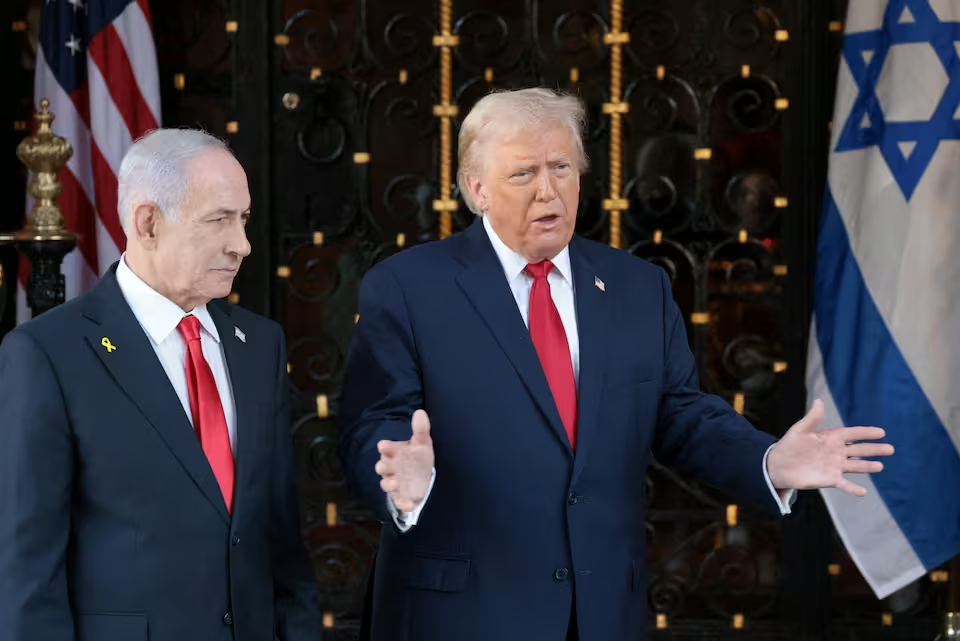
WASHINGTON, Nov. 3 — President Donald Trump said Tuesday he had reached a deal with Israeli Prime Minister Benjamin Netanyahu under which the United States would stop providing $4 billion in annual funding to Israel after this year. Washington would still sell weapons to its close Middle East ally.
The announcement came as a surprise while Americans headed to the polls for midterm elections that will determine whether Trump’s Republicans lose control of Congress. Trump framed the decision partly as a way to remove what he called a “bad talking point” that left-wing Democrats had used against Republicans over military assistance to Israel.
Trump gave no details on how the funding would stop at the end of the year. The existing Memorandum of Understanding that supplies $3.8 billion in US military aid to Israel each year runs until September 2028.
He appeared to recognize that aid to Israel, once a solid bipartisan consensus for decades, had turned into a political liability among some voters. Analysts described the declaration as an Election Day ploy.
Talks have already focused on how US assistance to Israel might change after 2028. Netanyahu has said he expects the aid to wind down over time.
Trump nonetheless signaled that he had settled on a shift in US-Israel relations, even while the two countries remain in conflict with Iran more than eight months after their joint attack on the Islamic Republic.
On Fox News’ “Fox & Friends,” Trump said Israel no longer needed the money and that some Democrats and left-wing politicians were using US financial support for Israel to attack Republicans. Opinion polls show overall American support for Israel has dropped, largely because of the Gaza war.
“Now, as far as paying Israel, Bibi Netanyahu and I have made a deal that we give Israel $4 billion a year, and we made a deal months ago that we’re stopping,” Trump said. “We’ve already agreed that by the end of this year we won’t be paying Israel. Now we’ll help Israel if they need it,” he added.
Israel’s leadership remains uncertain after the October 27 election. Netanyahu, who has aligned closely with US Republicans, lost his governing majority but left his opponents without a clear route to replace him. The outcome points to protracted negotiations over a new government.
Neither the White House nor Netanyahu’s office responded to Reuters’ requests for comment.
Gadi Eisenkot, who leads the rival bloc trying to oust Netanyahu, wrote on X: “The fact that the security establishment, along with Israeli citizens, is learning about a change in the strategic relationship framework through the media highlights just how much Benjamin Netanyahu’s conduct poses a genuine danger. We can no longer rely on him and must replace him.”
Criticism of Israel
US public support for Israel has fallen, especially among Democrats, since Israel’s harsh response in Gaza to the deadly Hamas-led cross-border attack in October 2023.
A Quinnipiac University poll in June found that 48% of voters and 66% of Democrats think the US is too supportive of Israel. Those figures stood at 16% and 20% when the question was first asked in 2017.
| Group | June poll: US too supportive of Israel | 2017 baseline |
|---|---|---|
| All voters | 48% | 16% |
| Democrats | 66% | 20% |
Polls and analysts expect Democrats to take the House of Representatives from Trump’s Republicans in Tuesday’s elections. The Senate remains in doubt.
Several candidates critical of Israel won Democratic primaries this past year. Even moderate lawmakers have grown more willing to question longstanding US support.
In a key battleground, Democratic candidate Abdul El-Sayed is running for the Senate from Michigan. El-Sayed, who would be the first Muslim US senator, has opposed unconditional military aid to Israel.
Trump said the left treated US funding as a “signal of unfairness” and that he wanted to eliminate an easy target. He named El-Sayed when explaining the decision to stop the money.
“Because they (Israel) don’t need it, and because why should we suffer the slings from lunatics like an El-Sayed when they don’t need it?” Trump said. “It’s a bad talking point.”
Some members of Trump’s Make America Great Again movement have also turned more critical of Israel. They accuse it of misleading the president, who campaigned on avoiding foreign interventions, into thinking Iran could be defeated easily. Polls show most Americans oppose the war, which has raised US gasoline prices and lowered Trump’s approval ratings.
“The curious issue is timing,” said Jon Alterman of the Center for Strategic and International Studies in Washington. “Why did President Trump announce it on Election Day? And why did he announce it amidst speculation that a major joint US-Israeli military strike against Iran may be days away?”
Some US supporters of Israel urged Trump to reconsider and phase out the funding gradually. Representative Ro Khanna, a progressive Democrat from California, said on X that “Zero aid Israel” would be part of his party’s agenda if it wins control of Congress.
Republican Representative Don Bacon told CNN, “What I really had heartburn about is the Israelis didn’t know about it.”
Congress authorized the funding in a 2020 law, but the Senate and House must still pass appropriations bills each year to release the money.
Netanyahu told an Israeli television channel in October: “If you think we’re going to continue receiving what I secured twice, and that’s tens of billions of dollars in American aid for the defense budget, prepare yourselves and get used to the fact that it won’t happen because America has changed.”
Looking ahead to a possible drop in US financial support, the House this summer passed a defense bill provision to deepen US-Israeli military technology ties. Section 219 of the 2027 National Defense Authorization Act calls for much closer defense cooperation. Dozens of NGOs have called the idea “exceptionally dangerous” and asked lawmakers to drop it.