
Blog
Big Man U Has Proud History With Purdue Basketball
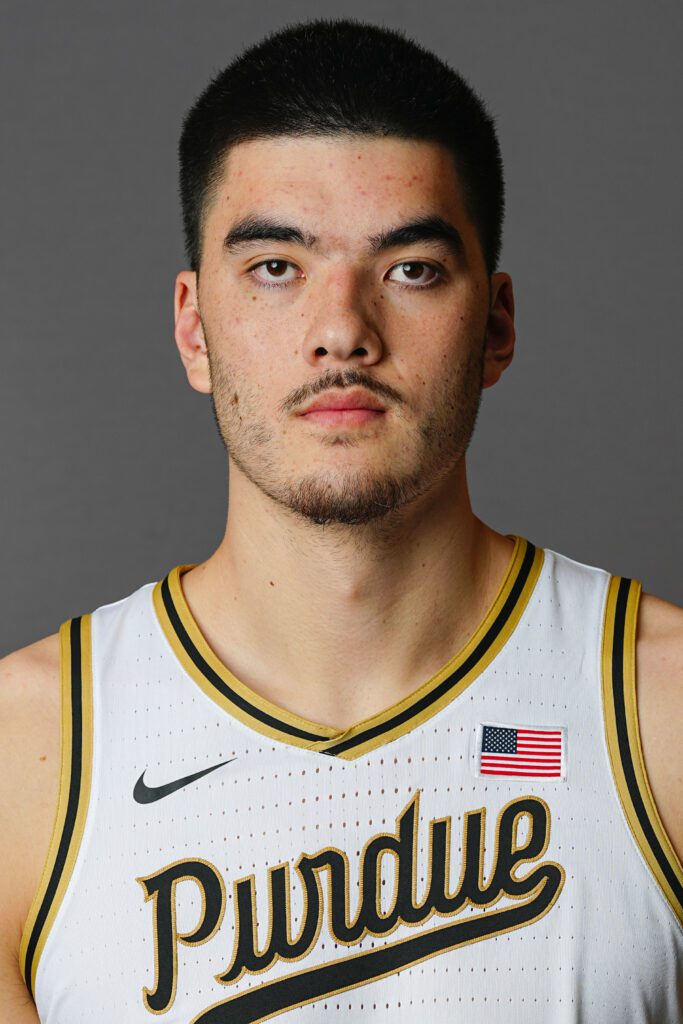
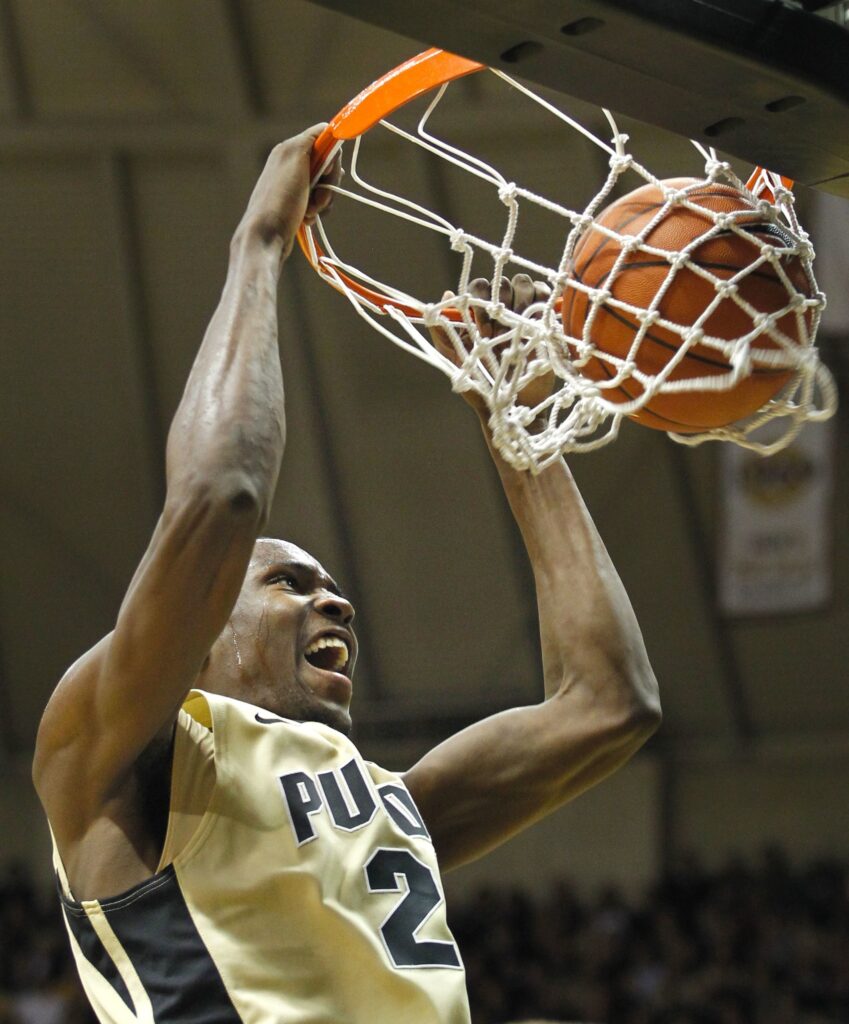
Photos courtesy Purdue Athletics.
During Matt Painter’s 21-year tenure leading the Purdue men’s basketball program, the Boilermakers have become known as “Big Man U.”
In an era when history is regarded by some as yesterday, Purdue has been the home of exceptional center play going back to before the 55-year-old Painter entered grade school.
In fact, the depth of outstanding centers at Purdue is such that a future NBA All-Star and two Big Ten Players of the Year didn’t even crack the top three of this list.
1. Zach Edey
The most decorated player in Purdue basketball history was a Plan C recruit for Painter after losing out on Hunter Dickenson (Michigan) and Ryan Kalkbrenner (Creighton).
Ranked No. 436 in the class of 2020, the 7-4 Edey would go on to become the first player in more than 50 years to win unanimous National Player of the Year honors in consecutive seasons. The last to do it was Bill Walton at UCLA in 1972 and 1973.
As a senior, Edey led Purdue to a 34-5 record and a spot in the national championship game for the first time in 55 years. He averaged 25.2 points and 12.2 rebounds.
Edey would break two of the longest-standing Purdue basketball records, scoring 2,516 points in four seasons to top Rick Mount’s three-year total of 2,323 set in 1970. Edey pulled down 1,321 rebounds to easily surpass the record set by the next center on this list.
2. Joe Barry Carroll
It’s approaching 50 years since Carroll recorded the only triple-double in Purdue history with 16 points, 16 rebounds and a school-record 11 blocks at Arizona on Dec. 10, 1977.
That was a foreshadowing of the impact the 7-1 Carroll would have at Purdue, one that would not have happened had assistant coach George Faerber not been in Denver a year earlier scouting another high school player.
Carroll’s 1,148 rebounds at the time were second-most in Big Ten history and stood as a school record for 44 years. His 2,175 points and 55 double-doubles at the time were second in Purdue history. Carroll blocked 349 shots, which was a school record and fourth-best in Big Ten history.
Blossoming under the guidance of coach Lee Rose, Carroll averaged 22.3 points, 9.4 rebounds and 2.8 blocks as a senior. Those totals earned Carroll consensus first-team All-America honors and helped Purdue reach the NCAA Final Four in 1980.
Carroll entered the Leroy Keyes Purdue Athletics Hall of Fame in 1995.
3. JaJuan Johnson
Purdue basketball history is full of transformation stories, a few of which we’ll detail later in this column. Johnson is one of them literally.
Weighing 195 pounds as a 6-10 senior at Franklin Central High School, Johnson still was ranked 42nd in the class of 2007 by Rivals.com.
As he began to put on weight and add strength, Johnson became one of the Big Ten’s best players of the 21st century’s first decade. He earned first-team All-Big Ten honors as a sophomore. By his senior season, Johnson was chosen Big Ten Player of the Year, Big Ten Defensive Player of the Year and Purdue’s first consensus All-American since Glenn Robinson.
Johnson also was the first Boilermaker to win the Pete Newell Big Man Award, launching Purdue and Painter’s reputation as developers of big men. Johnson was a first-round NBA Draft pick after leaving Purdue with 1,919 points.
4. Brad Miller
Miller could do it all during his time at Purdue from 1995 to 1998, becoming the first Boilermaker with at least 1,500 points, 800 rebounds and 250 assists. In 1997, he became the first center to lead Purdue in assists.
Miller averaged 17.2 points and 8.8 rebounds as a senior, leading Purdue to a 28-8 record and gaining attention of NBA scouts. The 7-foot Miller would go on to play 14 seasons in the NBA and was an All-Star in 2003 and 2004.
5. Russell Cross
The first McDonald’s All-American recruited by Gene Keady, the 6-10 Cross made an immediate impact.
He set the Purdue freshman scoring record, which still stands, of 540 points. Cross won Big Ten Freshman of the Year while helping Purdue go 21-11 and earn a third-place finish in the NIT.
After averaging nearly 15 points a game as a sophomore, Cross earned first-team All-Big Ten honors as a junior for leading Purdue to the NCAA tournament for the first time under Keady. Not long after an NCAA loss to Arkansas, Cross became Purdue’s first early entry into the NBA Draft.
A knee injury first suffered in high school, though, derailed Cross’ career after he was taken sixth overall by the Golden State Warriors in 1983. Cross played just one season, averaging 3.7 points in 45 games.
6. Jim Rowinski
I dare anyone to find a more startling physical transformation than the one that began during Rowinski’s junior season in high school.
Cut from the Syosset (N.Y.) varsity as a 5-10, 170-pound forward, Rowinski grew to 6-3 and 185 pounds and made all-conference as a senior. Because his father and sister were Purdue graduates, Rowinski decided to walk on for then-head coach Lee Rose.
In a short time, Rowinski went from “Renegade,” the name given by Rose to his practice squad, to a scholarship player for Gene Keady. Rowinski also developed from a 6-4 freshman to a muscular 6-8, 243-pound center.
Rowinski made his first start as a junior when Russell Cross was sidelined with an injury before the Sugar Bowl Classic. A season-ending injury shortly thereafter turned out to be the biggest break for Rowinski and Purdue.
Picked to finish ninth in the then-10-team Big Ten, the Boilermakers shocked the nation by winning a share of the title with Rowinski winning Big Ten Most Valuable Player honors
Rowinski was drafted by the Utah Jazz in 1984 and would play for the Detroit Pistons, Philadelphia 76ers and Miami Heat. He passed away at age 63 on Feb. 1, 2024.
7. Stephen Scheffler
Few Boilermakers in the late 20th century could make Rowinski look small. One of them was the 6-9, 250-pound Scheffler, who was recruited to play football by Notre Dame.
Like Rowinski, Scheffler would win Big Ten Player of the Year honors as a senior in 1990. Arguably the most polite player to wear a Purdue uniform – Scheffler would always say thank you to the referee who handed him the basketball before a free throw attempt – his lack of confidence nearly ended his Purdue career before he developed into the NCAA’s most accurate field goal shooter at 68.5 percent.
Described by the Chicago Tribune as “intelligent, outgoing, aware and articulate,” Scheffler also had to overcome dyslexia to earn a 4.9 average on Purdue’s then-6.0 grade-point scale. Scheffler had a good role model to follow. His elder brother Tom also overcame difficulties associated with dyslexia to play at Purdue from 1974-77 and later with the Portland Trail Blazers.
Stephen Scheffler was drafted in the second round of the 1990 NBA Draft by the Charlotte Hornets and spent seven seasons in the league, mostly with the Seattle SuperSonics.
8. Melvin McCants
Gene Keady once called McCants “one of the nicest kids” he’s ever coached.
Despite being a four-year starter, the 6-10 McCants was soft spoken and frequently overshadowed by outgoing teammates Troy Lewis, Todd Mitchell and Everette Stephens.
McCants was an important part of the back-to-back Big Ten championship teams in 1987 and 1988 because he gave Purdue a fourth scoring option. McCants never averaged less than 10 points a game over his career and finished with 1,554 points. He played one season in the NBA with the Los Angeles Lakers.
9. A.J. Hammons
Purdue’s streak of having at least one 7-footer on its roster began in 2012 with the man who former teammate Rapheal Davis and others consider the most talented center to wear the gold and black.
Hammons was dominant as a senior, averaging 15 points and 8.2 rebounds per game. He was named the 2016 Big Ten Defensive Player of the Year as well as first-team All-Big Ten. Hammons also was one of the five finalists for the Kareem Abdul-Jabbar Award.
The Dallas Mavericks chose Hammons in the second round of the 2016 NBA Draft but he played just one professional season.
10. John Garrett
Did you know that the 6-11 Garrett graduated from Purdue in 1975 as the school’s fourth-leading scorer (1,620 points) behind Rick Mount, Dave Schellhase and Terry Dischinger?
As a senior, he averaged 19.8 points and 10 rebounds per game. Garrett was twice selected to the Citizens Savings (formerly Helms) All-American team. He helped Purdue capture the 1974 National Invitation Tournament title.